
What is Autism?
Autism is a developmental disorder that typically appears during the first three years of life, and it may be the result of a neurological disorder that affects the development and function of the brain.
What happens in individuals with Autism?
Individuals with autism typically show delayed or abnormal development in language, social skills, and behavioral repertoire. Because autism is a spectrum disorder, individuals on the spectrum will share these characteristics but demonstrate them to different degrees. For example, some children may be high in verbal skills, but very low in processing social cues or sensory information from the environment. What works to support one child will not necessarily support all children with autism; there is no one-size-fits-all method to work-ing with these students. Every child needs to be looked at as an individual.
Sensory aspect of Autism:
Individuals with ASD struggle with sensory integration dysfunction. This is the inability to understand and process the information they receive from the environment through their senses. The senses include sight, hearing, taste, smell, touch, proprioception, and balance/coordination (vestibular sense). Sensory features (i.e., unusual behavioral responses to sensory stimuli) are highly prevalent and heterogeneous across individuals with ASD. From a developmental perspective, sensory response patterns are associated with and have cascading effects on other core symptoms in ASD.
Three types:
Sensory-seeking.
Sensory-avoiding.
Mixture of the two behaviors.
Sensory-seeking: Their nervous systems do not always process the sensory information that is coming into the brain. They are often under responsive to sensory input and will seek out more intense or longer-duration sensory experiences. They are often very busy and move a lot. They can sometimes appear to be aggressive or rough as they are less aware of touch or pain. They like loud noises and enjoy smelling people and/or objects.
Sensory-avoiding: Their nervous systems feel sensation very intensely and easily. We can notice a fight, flight, or freeze stress response to sensations, or sensory defensiveness. These children may appear to be very cautious, withdrawn, and uncomfortable with loud, busy environments. Many of them are very sensitive to touch and are picky about objects touching their bodies, such as clothing and shoes, as well as the foods they eat. These students can be seen covering their ears to drown out sound and often ask for no music during Yoga sessions.
How can Yoga help?
Yoga is a powerful tool that can teach children how to connect to their bodies, tap into their own personal strength, better deal with life’s challenges, and build connections with the outside world. There are many clinical reports on the positive results of Yoga with autistic children with autism. Yoga therapeutic interventions have been successful in addressing each of the core symptoms associated with a diagnosis of autism spectrum disorder (ASD).
Yoga therapy may help in inherently building the ability to exchange information to and fro through all senses that make a meaningful response, integrating senses in the central nervous system and enabling function of attention, emotion, cognition, coordination, arousal levels, and autonomous system.
Yoga is considered to provide sensory input through the primary tactile, vestibular and proprioceptive neurological pathways, as it involves moving through a composition of motor skills to perform the poses. These sensory systems are considered to be fundamental to sensory integration in order to develop the higher functions of balance, coordination, motor planning, attention, emotional stability and visual perception with the by-products of concentration, self-control and academic learning.
Yoga Poses
Yoga is a great way to strengthen these senses as your mind and body work together to complete the poses.
Postural control is a term used to describe the way our central nervous system (CNS) regulates sensory information from other systems in order to produce adequate motor output to maintain a controlled, upright posture. The visual, vestibular, and somatosensory systems are the main sensory systems involved in postural control and balance.
Yoga involves achieving and trying to maintain the different postures for as long as we can. So it helps regulate the central nervous system and in turn, sensory information.
A few yoga poses that can help are:
Vrikshasana/Tadasana (Tree Pose): Tadasana strengthens the nervous system. Brings in “Samasthiti” the sanskrit name for balanced state of body and consciousness. The calmness achieved through this posture helps reduce anxiety, increases awareness of the surroundings in individuals with ASD.


Virabadrasana (Warrior Pose): Psycho-emotionally, we aim for excellent security and stability in our base. On a physical level, we aim for a strong musculoskeletal and nervous system with Warrior pose. The nerve fibres and all the lower down structures like muscles and bones have more weight to them, and are obviously bigger and therefore more able to cope with nervous energy more easily. They are parasympathetic nerves that induce the relaxation response. This posture reduces stress and anxiety levels.
Chaturanga Dandasana (Plank Pose): It helps tone all the core muscles of the body including the abdomen, chest and the low back and will work your glutes. The wrists, arms and shoulders are all strengthened as are the muscles surrounding the spine, all of which will help you to improve posture. Builds up stamina, endurance and determination. Increased stability and strength of the neck will help to counteract ‘text neck’ and promote more peaceful sleep. It is also excellent for toning the nervous system.


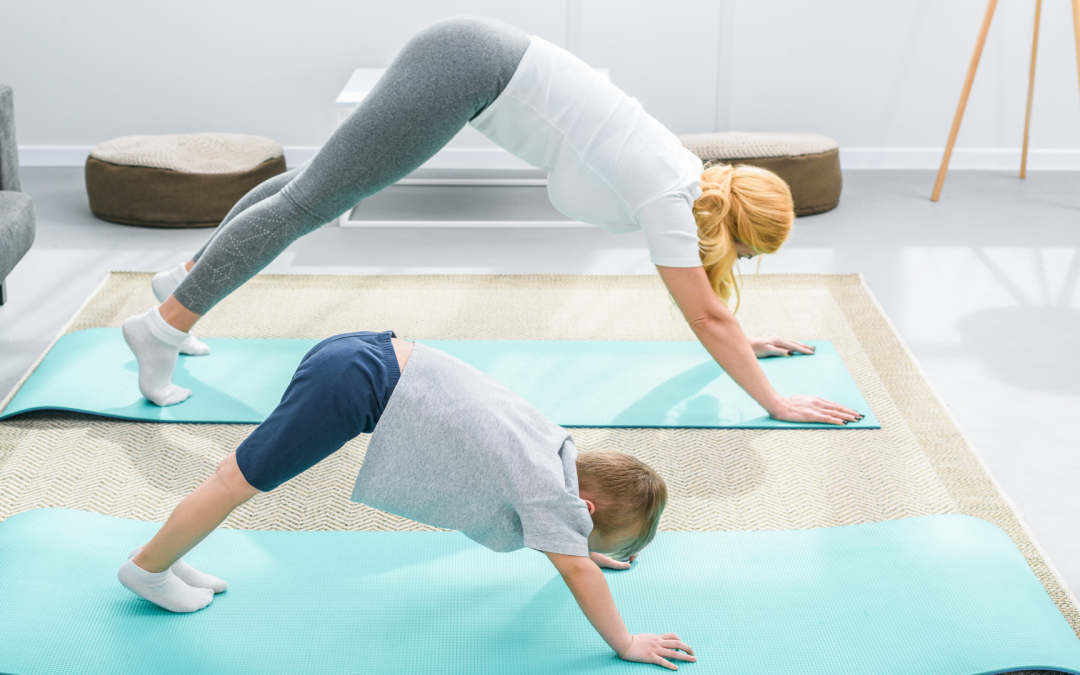
Athomukaswanasana (Downward facing dog Pose): This is great for promoting strength in the shoulders, arms, hands, and fingers, leading to better accuracy and control with handwriting, cutting with scissors and developing efficient grasp patterns. The legs are also strong and engaged in this pose, a great whole-body workout. A chance to experiment with being upside down, learning how to maintain balance and stability in a different position. Promotes overall flexibility.
References
Diagnostic and Statistical Manual of Mental Disorders Fourth Edition (Text revision) (DSM-IV-TR), Washington D.C.: American Psychiatric Association; 2000.
Volume 1. Diagnosis, Development, and Brain Mechanisms
Section II. Development and Behavior: Grace T. Baranek PhD, OTR/L, FAOTA, Lauren M. Little PhD, L. Diane Parham PhD, Karla K. Ausderau PhD, Maura G. Sabatos‐DeVito MS.
Sensory Nation. What is Sensory Integration Dysfunction? http://www.sensorynation.com/what.html. Accessed April 20, 2010.6. Khalsa SK. Yoga for children with Autism/SPD: A natural match. http://www.childrensYoga.com/TeachingTool/Articles/news_nd1211912525671.htm Updated 2008. Accessed April 7, 2010.
Kenny M. Integrated movement therapy: Yoga-based therapy as a viable and effective intervention for autism spectrum and related disorders. International Journal of Yoga Therapy, 2002;12:71-79.
Goldberg L. Creative relaxation: A Yoga-based program for regular and exceptional student education. International Journal of Yoga Therapy, 2004;14:68-78.
Betts & Betts, 2006; Cerebral blood flow changes during chanting meditation. Khalsa, Amen, Hanks, Money & Newberg, 1999; Segal et al., 2010; Orme-Johnson, 2006; Orme-Johnson, Schneider, Son, Nidich & Cho, 2006; Zeidan et al., 2011; Newberg, Wintering, Khalsa, Roggenkamp & Waldman, 2010).
Ayres AJ. Sensory Integration and the Child 2nd ed. USA: Western Psychological Services; 2005. 211 p.
Cuomo N. Yoga with a Sensory Integrative Approach: Integrated Yoga. 1st ed. USA: Jessica Kingsley Publishers; 2007.
Ivanenko Y, Gurfinkel VS. Human postural control. Frontiers in neuroscience. 2018 Mar 20;12:171.
Alcock L, O’Brien TD, Vanicek N. Association between somatosensory, visual and vestibular contributions to postural control, reactive balance capacity and healthy ageing in older women. Health care for women international. 2018 Dec 2;39(12):1366-80.